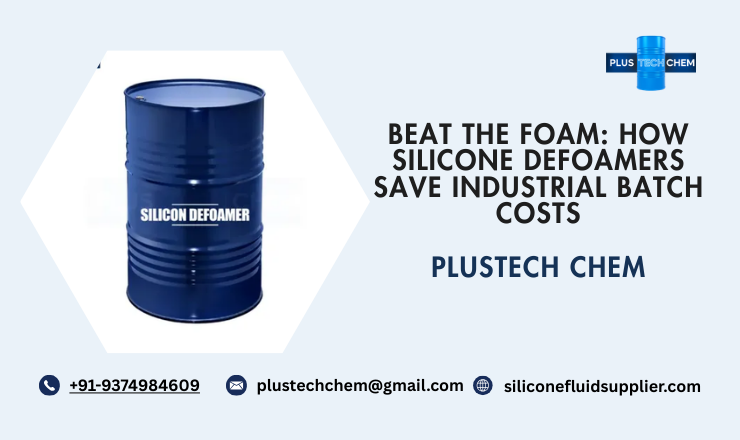
Foam is an expense. Foam silently occupies tanks meant for product while coating floors, thus forcing operators to reduce the speed of their production line from its full potential. The silicone defoamer helps solve this problem by bursting the bubbles immediately as they occur, hence making it one of the most reliable methods of industrial foam controlt. At Plustech Chem, customers keep asking us how it works in a running facility. This manual will provide the answer.
| DID YOU KNOW? “A dose of 5 parts per million can be enough. In a 200-litre drum, that comes to roughly one gram of additive.” |
What Is a Silicone Defoamer?
This is a liquid defoaming agent based on polydimethylsiloxane (PDMS). It is most commonly combined with hydrophobic silica powder. This substance is available as neat oil, as compound, or as an aqueous emulsion. All these types are silicone-based defoamer agents, while sometimes the same substance is referred to as a silicone antifoam agent. These terms are quite similar but not identical in meaning. The distinction is in that:
- Defoamer: Breaks foam that is already sitting on the surface.
- Antifoam goes in early, so foam never gets the chance to build.
- Which one do you need? Most grades cover both jobs.
How Does Silicone Defoamer Work?
Foam is gas trapped inside thin liquid skins, and surfactants, proteins or polymers keep those skins from tearing. The silicone defoamer working principle is to weaken that skin until it fails. Two stages make it happen.
Spreading Across the Foam Film
Water has a surface tension of about 72 mN/m. Silicone oil sits near 20 mN/m. That gap lets a droplet slip into a bubble wall and spread across it, provided the grade suits your liquid. Step by step, this is what follows:
- First contact: The droplet touches the film between two bubbles.
- It moves outward and shoves surfactant molecules out of the way.
- Result? A thin, weak spot in the wall.
Foam Film Destabilization and Bubble Collapse
Once the wall is thin, it has no strength left. It tears. The bubble pops, and its neighbours lose their support. Watch for these signs in your tank:
- Big bubbles go first.
- Smaller ones collapse right behind them.
- Foam height rapidly reduces after application, allowing the liquid to be sucked back into the mixture.
Why Is Silicone Defoamer Used in Industrial Processes?
Foam takes space. Factories partially fill their tanks to allow space for foam formation; anything beyond that requires mopping and losses in terms of wasted material and time. The following are some of the silicone defoamer benefits that are readily noticeable:
- Consistent operation, without stopping operations due to the frothy tank.
- Less spillage, thus ensuring safety and quick cleanup.
- Accurate filling becomes easy because you are pouring liquid, not foam.
- Pinholes, craters and fisheyes in coatings drop.
- Need more output? Tanks can be loaded closer to full volume.
| TRIVIA: “Silicone antifoams reached factories in the mid-1900s, and they still sell well because a tiny dose does the job.” |
Major Industrial Applications of Silicone Defoamers
Wherever liquid is shaken, stirred, pumped, heated or aerated foam will form. This means silicone defoamer applications are a very wide-ranging one, however, different processes will require unique solutions. These are the main industries:
- Wastewater treatment: Aeration tanks and clarifiers, where surfactants pile up.
- Dyeing and finishing baths in textile units.
- Paint and coating plants, mainly at the grinding and mixing stage.
- Pulp and paper washing, screening and stock preparation.
- Reactors, evaporators and storage tanks in chemical plants.
Silicone Defoamer Products Used in Industrial Applications
Looking for Silicone defoamer suppliers in India? Plustech Chem lists two products on its website. They suit different conditions, so read the data sheet before you swap one for the other.
Metroark Silicone 21 Defoamer
This is a non-ionic, water-dilutable silicone emulsion. It fits textile, paper and other compatible water-based systems.
Wacker Silfoam SE 35 Antifoam Emulsion - Defoamer
This one is a silicone antifoam emulsion. Before you choose it, check three things:
- Whether it suits your application.
- The product specifications.
- Manufacturer guidance on use and handling.
Factors That Affect Silicone Defoamer Performance
Same product, different results. Conditions in your plant decide which one you get. Check these points to maintain silicone defoamer performance:
- Dosage: Too low results in foam, while too high can lead to greasy marks and flaws.
- Hot baths might require a heat-resistant defoamer.
- pH. Strong acids or bases can destabilize the emulsion.
- High amounts of surfactants make foam less destructible.
- Does it blend well in your mixture? Do a test on a sample.
- Inefficient blending causes aggregation of droplets, which makes them less effective.
How to Select the Right Silicone Defoamer for Industrial Applications
Selection of an appropriate Silicone Defoamer is contingent upon the kind of liquid, process conditions and the presence of foam formation in the process. An appropriate defoamer ensures foam control without any negative impact on the quality of the end product. Before the selection of a grade, it is essential to consider the following aspects:
- Process: It may involve wastewater treatment, textile process, paint production or chemical production.
- Chemical Compatibility: It may be compatible with the liquid and other ingredients involved in the process.
- Operating Temperature: The selection of grade is based on the operating temperature of the process.
- Foam Formation: Whether there is formation of foam during mixing, pumping, heating and aeration.
- Dosage: It should be in accordance with the required dosage given by the manufacturer.
- Specifications of the Product: It should be according to the technical data sheet.
Testing the selected grade on a sample will help in determining its compatibility and proper dosage.
How to Use Silicone Defoamer in Industrial Processes
Proper use of silicone defoamer is essential for proper foam control. The methods of application of silicone defoamer may differ depending on the particular product formulation and industry process in use. Some of these include the following:
- Identification of Foam: Identify the time at which foam occurs like in mixing, pumping, aeration, and filling.
- Checking Technical Data Sheet: Review the technical data sheet of the product for the recommended dosage and dilution information.
- Dilution of Product: The product is to be diluted only when suggested by the data sheet of the manufacturer.
- Point of Addition: Defoamer can be added only when there is foam or you wish to prevent the formation of foam.
- Effectiveness of the Process: Verify the effectiveness of the product in foam control during the process being used.
- Adjust Dosage: Where required, adjust dosage based on trial.
It is advisable to conduct a trial using the product before using it in a whole production batch.
Why Choose Plustech Chem for Silicone Defoamers?
Buyers comparing Silicone defoamer manufacturers and suppliers want straight answers before they order. Plustech Chem keeps the process plain. Here's what you can expect:
- Defoamer grades available for enquiry and quotation.
- Documents for each grade, shared on request.
- Help picking a grade for your process and plant.
- Bulk orders handled for industrial users too.
Conclusion
A silicone defoamer works in two moves: it enters the foam wall, then thins it until bubbles burst. Pick the grade that matches your liquid, temperature and pH, and your process runs cleaner. To discuss the right grade for your plant, send an enquiry to Plustech Chem.
FAQs
Q1. Explain how a silicone defoamer prevents foam formation in industrial liquids.
Silicone defoaming agent works on the basis of penetrating the film which surrounds the air bubbles; making it weak. When this film gets ruptured, air bubbles burst leading to the removal of the foam.
Q2. Are there any differences between a silicone defoamer and a silicone antifoam agent?
There is one major difference, which is the time of application. A defoamer is applied in order to eliminate foam that has already been formed, whereas an antifoam agent is used for preventing foam formation.
Q3. Which industries use silicone defoamers for foam control?
The applications include waste water treatment, dyeing of textiles, manufacture of paints, production of paper and chemicals. The silicone defoamers are applied in these industries to control foam in operations such as mixing, pumping, aeration and where air is mixed in liquids.
Q4. What is the dosage for silicone defoamers?
The dosage is determined by the type of the liquid, foam level and the formulation of the product. In some cases, only a few parts per million may be needed.
Q5. Can silicone defoaming products be used in water-based industrial systems?
Silicone defoaming products can also be found in water-dispersible form suitable for use in compatible water-based systems. They are typically used in the processing of textiles, paper making and waste water treatment.
Q6. What can happen if there is an excess of silicone defoamer in the system?
Excess use of silicone defoamer can have some undesirable results like greasy stains, surface imperfections or other issues in coating. There could also be unnecessary increases in the cost of production without an improvement in foam management.